Integral Post is a high-profile blog series that features essays and articles from many of our favorite Integral teachers, leaders, and artists, offering exciting updates and observations from their respective corners of the Kosmos. These are some of the real movers and shakers of the Integral movement, whose work is helping to create and sustain a new era of problem-solving and self-discovery—reaching all the way from academia to pop culture to the inner-most heart of the world's great spiritual traditions.
Join Helen Palmer, Terry Saracino, Leslie Hershberger, and Renée Rosario on April 21-22, 2012 in Boulder, CO for Compassionate Presence: Where the Narrative Enneagram and Integral Theory Meet. Click here for more details!
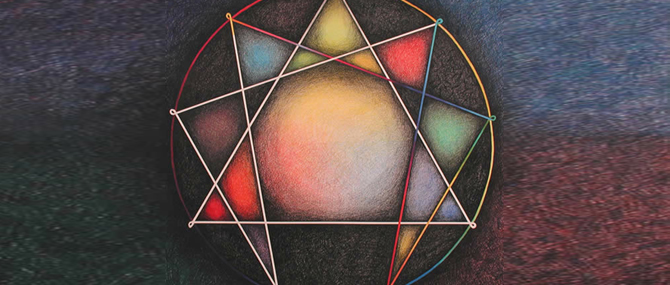
The Enneagram identifies the cognitive-emotional habit of nine types. Each type as its own habitual attentional style with a core emotion that drives the pattern. Within this structure, there is a somatic response that accompanies the emotion. There are three primary afflictive emotions in Enneagram theory which are concurrent with neurobiological research: anger, fear and panic at loss of connection. (Jack Killen MD, David Daniels MD, Dan Siegel, MD). These three primary emotions correspond with the three centers of the Enneagram (Anger: Body, Fear: Head and Panic: Heart).
Recently, I received an e-mail from a woman who wanted to know if I could help her daughter. I had seen her for an Enneagram typing interview a few years back and she was a concerned mother with a daughter who'd had some challenges. Through the conversation, I recognized the mother was taking on her daughter's problems as her own and was helping create a cycle of dependency. Mom was a 2, a type whose attention goes to other people's needs. Each time I gently shifted the discussion to her own needs, she became visibly uncomfortable and wanted to talk again about her daughter. I suggested we work together on her own anxiety over her daughter's challenges and that could ultimately prove to be beneficial for her daughter. I didn't hear from her again until last week when she emailed me to see if I knew anyone who could help her daughter who was already in therapy.
Then, last week, I saw a Facebook post about the contraception issue being played out on the U.S. political stage. Someone who knew the Enneagram began to suggest the poster was angry and then began to evaluate his Enneagram style and make a rather startling array of assumptions. After he was done with that, he then typed the politician in question and told the poster that the politician must have evoked buried shadow! It felt like an assault of sorts in which someone who has access to an elegant psycho-spiritual map of integration uses it as a bludgeon to take a dissenter down. Not a good idea.
Most of us who know the Enneagram have seen this in ourselves and others and it's not only disrespectful, but also abuses the system the same way religionists misuse sacred texts by turning it into a screen for their own projections without working the deeper, more illuminating elements which can actually engender inner shifts in consciousness.
I'm trained in the Enneagram in the Narrative Tradition which is an antidote to misuse of the Enenagram because we use it as an unparalleled tool in developing the capacity for inner witnessing as a 1st person practice and compassionate presence as a 2nd person practice. In this article, I'll explore 1st person practice and next week, we'll look at 2nd person practice.
1st Person Practice
I'm a head type (types 5, 6, and 7 are mental types) on the Enneagram so the primary emotion activated within me is fear which usually centers around a fear of the unknown, meaninglessness, of not being prepared or of feeling incompetent. Cognitive dissonance is its own private hell as I can get thrown off if all the pieces don't fit together. As a fear type, I turn things over and over in my mind which often paralyzes me from taking the action that most matters to me (even though I may look busy). As a 7, the subtle gradation of fear is an emotional passion of gluttony in which I cope with the fear by imagining plans, possibilities and positive outcomes to avoid feeling emotional pain and limitation. Because of the emotional driveshaft of gluttony, my mental attentional style is planning.
When I face an imagined fear of pain, a fear of limits or criticism, the emotion starts to cook. It’s happened at least twice just in the writing of this article. My type structure begins to scatter my attention and energy and lose focus.
So, in traditional Enneagram use, I might be able to tell you about what is happening. I would explain all sorts of Enneagram theory that explains why I do what I do. I might trace childhood patterns, talk about my 8 wing, my social subtype, and the subtle nuances of my 7 type structure and maybe throw in stages of consciousness to flesh it out even more. As an extravert, I might call a friend or two and talk about how my type keeps me stuck in planning. This keeps me safe and certain as there is a crescendo of understanding that offers a sort of intellectual orgasm. Nothing better for head type than to have well-researched system and some answers.
If I were a heart type, different issues might show up and I might use the Enneagram to feed my compulsion to create connection outside of myself and if I were a body type, I might try learn theory in order to control the strong instinctual feelings of vulnerability in my body or try to control the world outside of myself.
Yet, there is a body of teaching which shifts us beyond mental understanding of the Enneagram for it recognizes our type is an energetic contraction against our life force which protects us when we experience fear, anger or panic. (In Enneagram terms, each type has a “vice” and “virtue” and the root word of “virtue” is virs which is Latin for life force). It invites us into a felt sense of our own intuitive body wisdom.
It begins by bringing a faculty of spiritual awareness known as the Inner Observer. The Inner Observer is separate from type and can witness placements of attention. It notices not only the cognitive/emotional habit of the type, but also the inner somatic reaction. In my case, my breathing grows shallow, I feel an energetic density in my heart, anxiety in the solar plexus and I can barely feel my feet on the ground.
From an Integral perspective, this is a shift from 3rd person knowledge about type to a 1st person practice of three centered self-observation. Broken down, it looks like this....
In the 10th installation of the Integral Cinema Studio series, Mark Allan Kaplan uses the film 2001: A Space Odyseey to illustrate the "Energetic Lens" of integral film interpretation....
As an art form, painting has the potential to engage both artist and audience on multiple levels at once. I think a great painting is one that goes beyond the ordinary in each of these layers. With apologies to deconstructionists and abstractionists everywhere, for me this is particularly true of representational painting. The simple reason being that it contains within it more layers than abstraction. Everything that is "in" an abstract painting is present within a representational piece, but not vice-versa....
What is Integral Art? This has been an open and ongoing discussion for years within the integral community—and doesn't seem to have gone very far beyond a slightly more sophisticated version of "well, you know it when you see it". Fortunately, we have Michael Schwartz to help move the conversation forward.
In this video, recorded at the 2011/2012 Kosmic Creativity event, Michael uses several examples from the Integral Life Art Galleries to point to some of the emergent properties and qualities of Integral Art, and helps us understand what sets this new aesthetic apart from everything else that we've seen before....